

Introduction-
Table of Contents
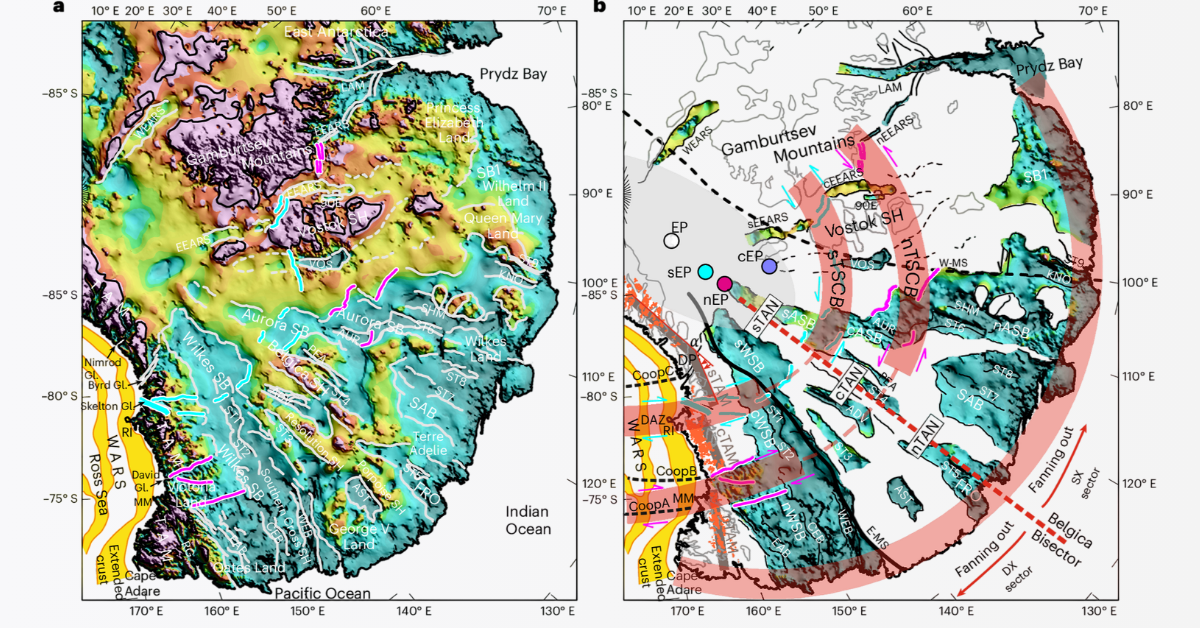
Antarctica, one of Earth’s most mysterious and least explored regions, has once again astonished scientists. Researchers recently discovered a massive “fan-shaped” geological structure beneath the thick ice sheets of East Antarctica, dubbed the East Antarctic Fan-Shaped Basin Province (EAFBP). This continental-scale structure connects several large basins beneath the ice and holds important clues to Earth’s geological history dating back millions of years.
Scientists believe this discovery could help improve understanding of Antarctica’s hidden geography, ancient tectonic activity, and the evolution of continents. Furthermore, this study could prove crucial for assessing ice sheet dynamics, climate change, and future sea-level rise. This is why the EAFBP is considered one of the largest and most important scientific discoveries in recent years, attracting the attention of the global scientific community.
What is the EAFBP?
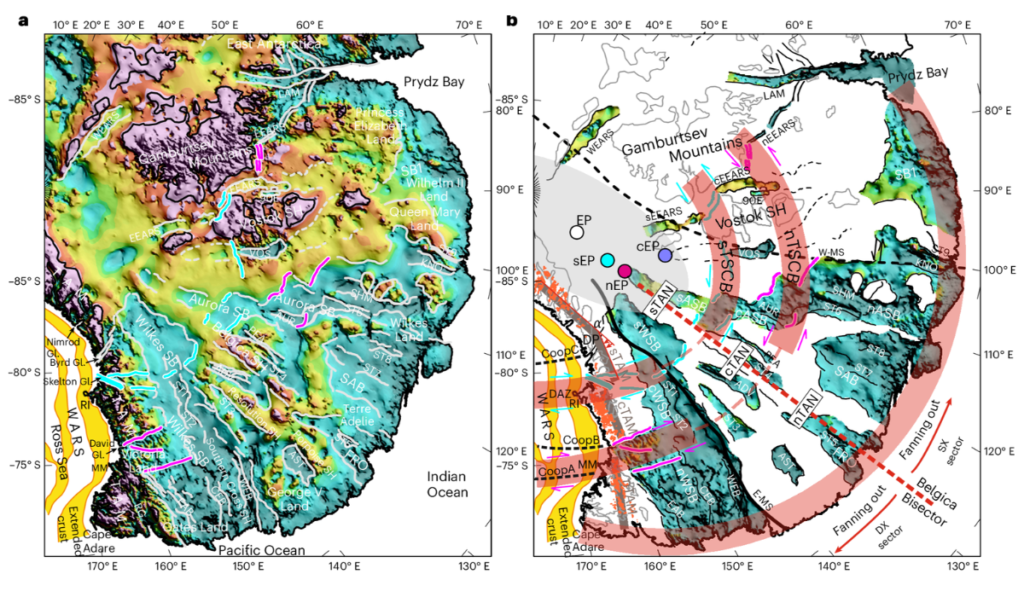
The East Antarctic Fan-Shaped Basin Province (EAFBP) is a massive geological structure hidden beneath the East Antarctic ice sheet that has attracted significant attention in recent scientific studies. This discovery is considered an important step toward understanding Antarctica’s geological history and evolution.
What Does the Name Mean?
The EAFBP stands for East Antarctic Fan-Shaped Basin Province. “Fan-shaped” refers to a fan-shaped structure, while “Basin Province” refers to a vast area comprised of several interconnected sedimentary basins. According to scientists, this entire structure forms a fan-shaped structure, expanding outward from the center.
Where Is It Located?
This massive structure lies beneath the East Antarctic Ice Sheet. Covered by thick ice, it remained hidden from scientists for millions of years. Its extent has been observed as far as the South Pole.
How large is it? The EAFBP is believed to be continental in size. It connects several well-known subglacial basins, making it one of Antarctica’s largest geological structures. Its magnitude suggests that East Antarctica’s geological history may have been more complex and dynamic than previously thought.
How Did Scientists Make This Discovery?

Identifying a massive structure like the EAFBP, hidden beneath kilometers of ice in East Antarctica, was no easy task. Scientists used modern geophysical techniques and years of data collected. These advanced methods helped researchers create a detailed picture of the landforms beneath the ice and made a significant discovery.
Modern Technologies for Seeing Under the Ice-
Scientists first used ice-penetrating radar, which can penetrate thick layers of ice to reveal the structure of the ground beneath. Furthermore, gravity data provided information about the density of underground rocks and basins. Magnetic surveys helped identify ancient geological structures, while seismic studies played a crucial role in understanding the depth and texture of the layers and landforms beneath the ice.
A New Picture Emerged from Combining Data-
When data from various sources was analyzed together, scientists made a surprising discovery. Basins previously considered separate geological units were actually part of a larger, interconnected structure. New digital mapping and three-dimensional modeling techniques helped clearly reveal this fan-shaped structure.
In Which Journal Was the Research Published?
The research related to this important discovery was published in the prestigious scientific journal Nature Geoscience. The study has opened up new debate and research possibilities regarding the geological evolution of East Antarctica.
The EAFBP’s Most Surprising Features-

The East Antarctic Fan-Shaped Basin Province (EAFBP) is of greatest interest to scientists due to its extraordinary structure and enormous size. It is not just a typical geological region, but a continental-scale structure composed of several large sub-glacial basins, providing important clues to Antarctica’s geological history.
Massive Basins Hidden Beneath the Ice-
The EAFBP’s most remarkable feature is that it encompasses several well-known sub-glacial basins. These include Wilkes Basin, Aurora Basin, and Lake Vostok Basin. Previously, these basins were considered separate geological units, but new studies have revealed that they are all part of a vast, interconnected structure.
Structure Under Ice More Than Three Kilometers Thick-
This entire structure is buried beneath East Antarctica’s thick ice sheet. In some areas, the ice thickness exceeds 3 kilometers, keeping this geological mystery hidden for millions of years. Modern technologies have revealed their true nature for the first time.
Pattern Spreading from a Central Point near the South Pole-
According to scientists, the EAFBP has a fan-like appearance. This structure appears to spread in different directions from a central area near the South Pole, pointing to a unique geological process that led to its formation.
One of the Largest Structures of its Kind on Earth-
Due to its vast expanse and complex structure, the EAFBP is considered one of the largest sub-glacial geological structures ever discovered on Earth. This discovery could play a significant role in understanding the geological evolution of not only Antarctica but the entire planet.
How Did this Structure Form Millions of Years Ago?
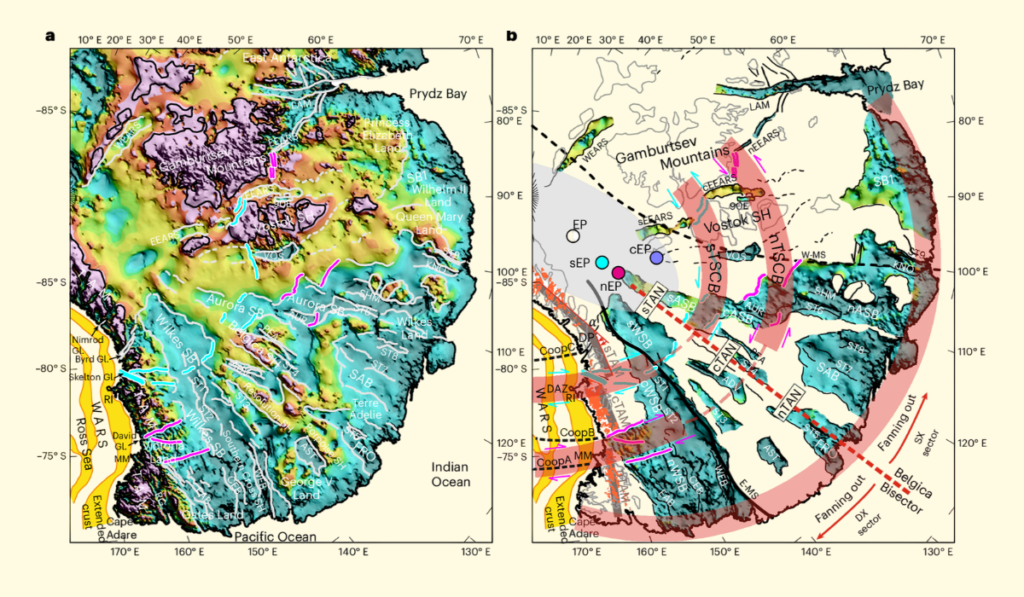
Scientists believe that the East Antarctic Fan-Shaped Basin Province (EAFBP) was formed millions of years ago due to major geological changes in the Earth’s crust. Studying this massive structure not only helps us understand Antarctica’s past but also reveals how today’s continents came to be. According to researchers, its origin may be linked to ancient tectonic activity and the breakup of the Gondwana supercontinent.
What is “Rotational Extension”?
Scientists use the theory of “rotational extension” to explain the formation of the EAFBP. This is a geological process in which the Earth’s crust gradually stretches and expands. During this process, cracks develop in the rock layers, creating large basins. According to research, the EAFBP’s fan-like shape may be the result of this process, in which the structure appears to spread outward from a central region, much like a fan unfolding.
The Breakup of the Gondwana Continent-
About 150 to 180 million years ago, Antarctica, Australia, India, Africa, and South America were part of the giant supercontinent Gondwana. Over time, this continent began to break apart due to the movements of tectonic plates. Scientists believe that the EAFBP may have formed during the same process of geological tension and extension that broke Gondwana into separate continents.
Geological Signals of 150 Million Years Ago-
Geophysical evidence found in the study indicates that the EAFBP began to develop approximately 150 million years ago. The patterns observed in its structure provide clear indications of ancient tectonic activity, crustal expansion, and continental reorganization. This is why scientists are considering this discovery as an important link in the geological history of the Earth, which can provide a new direction in understanding the hidden past of Antarctica.
Will this Discovery Change Our Understanding of Antarctica?

The discovery of the East Antarctic Fan-Shaped Basin Province (EAFBP) has challenged scientists’ traditional understanding of Antarctica. East Antarctica has long been considered one of Earth’s oldest and most geologically stable regions. However, this new discovery suggests that its geological past may have been more complex and dynamic than previously imagined.
Challenging the Concept of a Stable Continent-
Until now, scientists believed that East Antarctica had experienced very little geological change for millions of years. However, the discovery of the EAFBP indicates that large-scale tectonic activity and crustal expansion occurred here in the past. This massive fan-shaped structure suggests that the continent’s evolution has been influenced by more active geological events than previously thought. This could lead to a re-examination of many old theories about Antarctica’s formation and evolution.
New Questions for Scientists-
This discovery has also raised many new questions for scientists. Could other such massive structures lie hidden beneath the ice of East Antarctica? Will more advanced technologies reveal new geological mysteries in the future? Researchers believe that many undiscovered and unsolved mysteries still lie beneath Antarctica. The discovery of the EAFBP could be just the beginning, opening new avenues for understanding Earth’s history in the years to come.
What Impact does this have on Antarctica’s Ice?
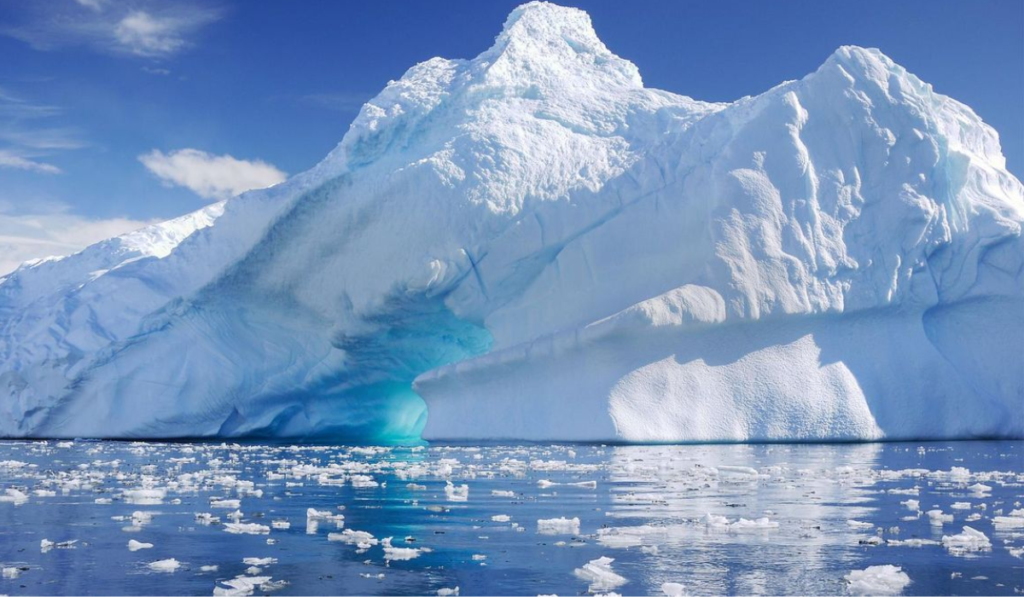
The East Antarctic Fan-Shaped Basin Province (EAFBP) is not just a geological discovery, but it could also hold the key to understanding the behavior of Antarctica’s vast ice sheet. Scientists believe that landforms beneath the ice directly influence ice flow, its stability, and future changes. Therefore, studying the EAFBP is considered extremely important for climate science.
The Basis Controlling Ice Movement-
Antarctica’s ice is not static, but slowly flows in various directions. The speed and direction of this flow largely depend on the landform beneath the ice. If deep basins, valleys, or slopes exist beneath, they can provide pathways for the ice to move in a certain direction. Large structures like the EAFBP could be one of the key factors influencing ice dynamics.
Formation of Subglacial Lakes and Water Systems-
Several areas within the EAFBP exist where water accumulates beneath the ice, forming subglacial lakes. The most famous example is Lake Vostok, considered one of the Earth’s largest subglacial lakes. These lakes and water systems can reduce friction beneath the ice, affecting ice flow.
Role in Climate Change Studies-
Understanding the geological structure beneath the ice allows scientists to develop more accurate models of future ice melt rates and sea-level rise. Information from structures like the EAFBP will help better assess the impacts of climate change. This can make it easier to understand potential risks to coastal areas around the world and make future plans.
Latest News: Why did the June 2026 Discovery Create a Scientific Stir?
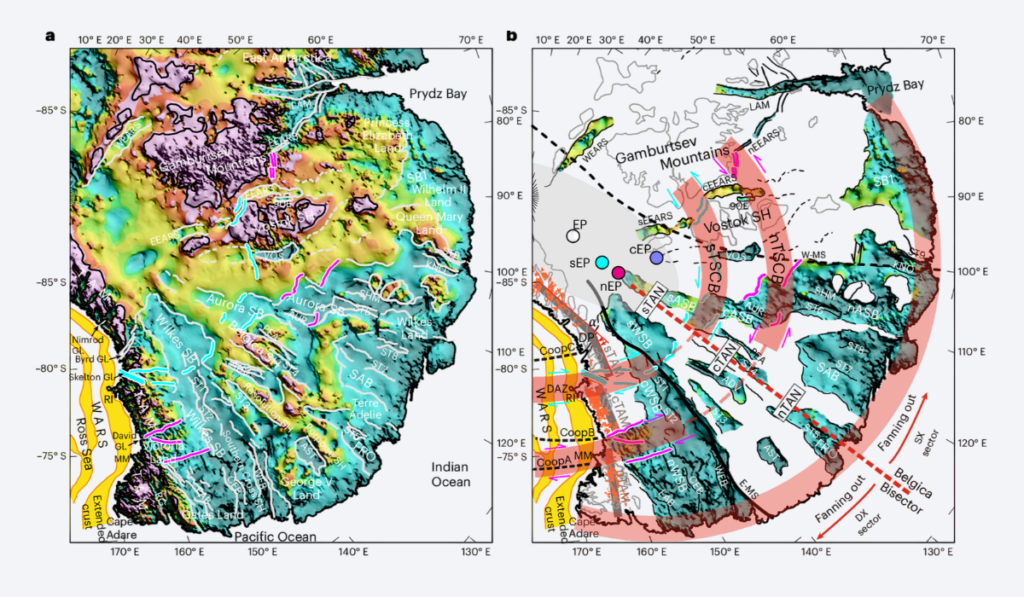
A landmark study published in June 2026 reshaped scientists’ understanding of Antarctica. After analyzing several large basins beneath the ice of East Antarctica, researchers concluded that they were not separate structures but part of a single, larger geological system. Based on this discovery, the region was named the East Antarctic Fan-Shaped Basin Province (EAFBP).
For the First Time, All the Basins were Identified as a Single Entity-
The major achievement of this study was that for the first time, scientists identified major sub-glacial regions such as Wilkes Basin, Aurora Basin, and Lake Vostok Basin as a common geological structure. This has opened a new perspective on understanding the geological evolution of Antarctica.
The Role of the International Scientific Team-
This discovery is the result of collaboration between geologists, glaciologists, and geophysicists from various countries. The identification of this massive structure was made possible by a combined analysis of modern radar technology, satellite data, and geophysical surveys.
Reaction from Media and Scientific Institutions Worldwide-
Following the discovery, scientific institutions and leading media organizations worldwide recognized it as one of the most significant scientific achievements in recent years related to Antarctica. Experts believe this study will provide new insights into Earth’s ancient geological history.
What Future Research Will Follow?
Scientists are now planning to conduct more detailed geophysical surveys of the EAFBP. Future research will focus on its impact on ice stability, the role of subglacial water systems, and new interpretations of Antarctica’s geological evolution. This will also contribute to more accurate predictions of climate change and sea-level rise.
What is the Connection between the EAFBP and Climate Change?

The discovery of the East Antarctic Fan-Shaped Basin Province (EAFBP) is not limited to geology, but is also directly related to the study of climate change. Scientists believe that without understanding the geological structures beneath the Antarctic ice sheet, it is difficult to accurately predict future ice melt and sea-level rise.
Why is the Geography Beneath the Ice Important?
Basins, valleys, and rock formations beneath the ice determine the direction and speed of ice movement. A massive structure like the EAFBP can affect ice flow and its stability. Therefore, studying it is crucial to understanding the current and future state of Antarctica.
Future Ice Melt Models-
Climate scientists use computer-based models to predict the impact of rising global temperatures on Antarctica’s ice. New information from the EAFBP can help make these models more accurate, allowing for better predictions of future conditions.
Improving Sea-level Rise Predictions-
If scientists can better understand the actual landforms beneath the ice, they will be able to make sea-level rise projections more reliable. This will make it easier to identify areas at potential risk.
Global Impacts-
Changes in Antarctica’s ice are not limited to the polar regions. They can impact coastal cities, marine ecosystems, and global climate systems around the world. Therefore, studying the EAFBP can play a vital role in understanding the impacts of future climate change and developing strategies to address them.
Interesting Facts About This Discovery-
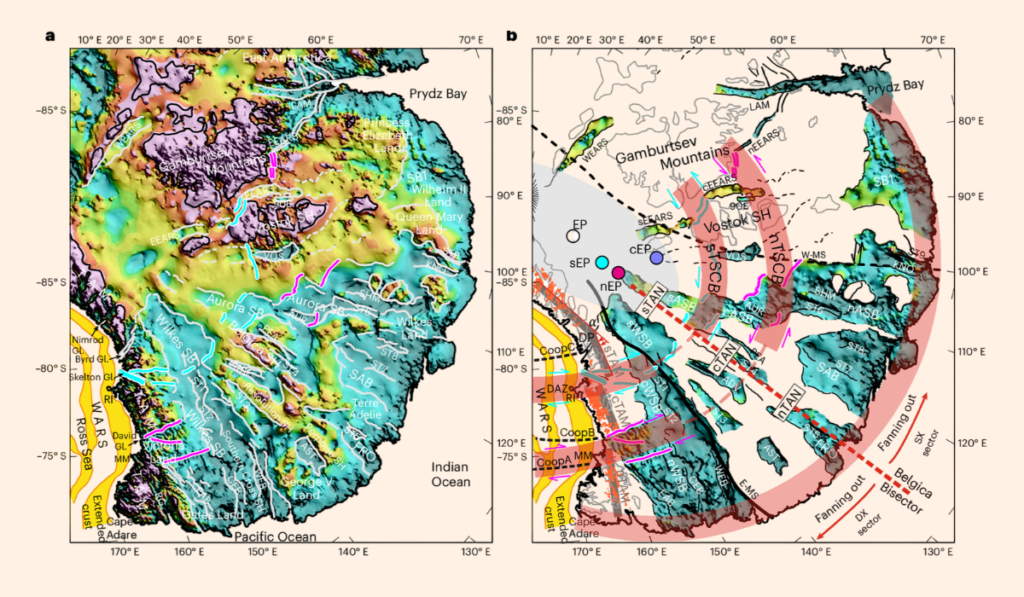
The discovery of the East Antarctic Fan-Shaped Basin Province (EAFBP) is associated with several fascinating facts, making it one of the most exciting scientific discoveries of recent years.
- The EAFBP is a structure completely hidden beneath the thick ice sheet of East Antarctica, so it remained hidden from scientists for a long time.
- The ice thickness in some parts of this region exceeds 3 kilometers, making its discovery even more challenging.
- This massive structure appears to spread in different directions from a central region near the South Pole, creating its fan-like appearance.
- The EAFBP includes important areas such as Lake Vostok, home to one of Earth’s largest subglacial lakes.
- Scientists believe its formation may be linked to tectonic activity during the breakup of the Gondwana continent millions of years ago.
- This discovery has the potential to give a new direction to the study of the geological history and climate of Antarctica.
If you’re looking for information on educational topics, be sure to check out our website, edublog.cloud. Additionally, for digital products, be sure to check out our other website, vijaybooks.store.
Information related to SpaceX IPO & SpaceX Stock, Elon Musk’s Net Worth 2026, is also available on this website.
Frequently Asked Questions (FAQs) about: East Antarctic Fan-Shaped Basin Province (EAFBP)-
What is the East Antarctic Fan-Shaped Basin Province (EAFBP)?
The EAFBP is a vast geological structure located beneath the East Antarctic ice sheet. It is composed of several interconnected sub-glacial basins and has a fan-like shape.
When was the EAFBP discovered?
The landmark study identifying this structure was published in June 2026. Subsequently, the discovery became a topic of discussion among scientists and research institutions worldwide.
How large is this structure?
The EAFBP is considered a continental-scale structure. It spans a vast area of East Antarctica and connects several major sub-glacial basins.
How did scientists discover it?
Researchers analyzed the structures beneath the ice using ice-penetrating radar, gravity data, magnetic surveys, and seismic studies. Combining these data revealed this vast system.
What is its connection to climate change?
The EAFBP can affect the flow and stability of ice. Therefore, its information is important for understanding the effects of climate change and future ice melt processes.
Will this discovery help understand sea-level rise?
Yes, knowing the actual landforms beneath the ice will allow scientists to develop more accurate climate models, leading to better estimates of sea-level rise.
What is its connection to the Gondwana continent?
Scientists believe that the formation of the EAFBP may be linked to tectonic activity and the expansion of the Earth’s crust during the breakup of the Gondwana continent millions of years ago. This structure provides important evidence of that ancient geological history.
Conclusion-
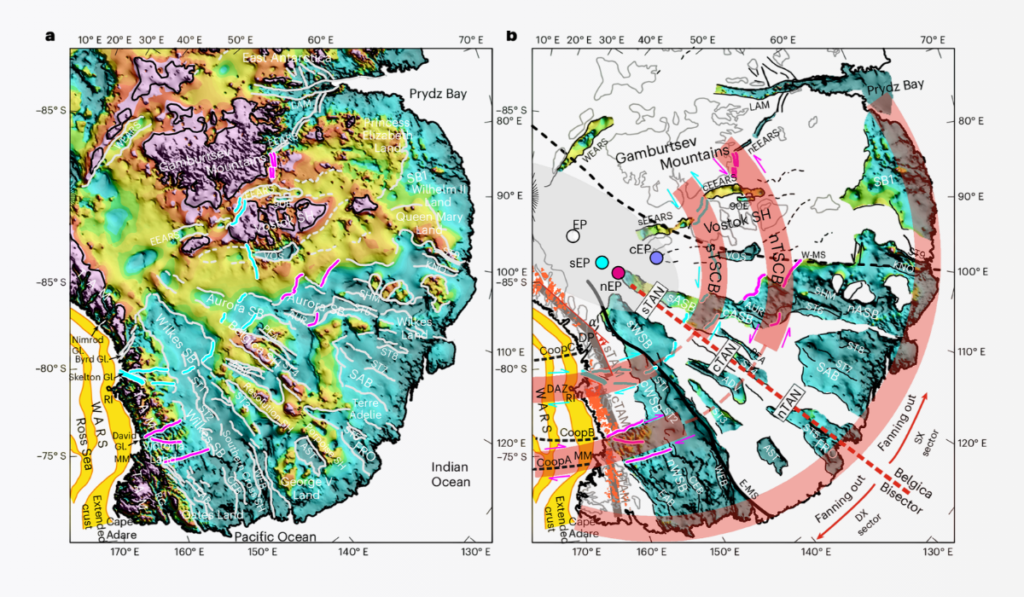
The East Antarctic Fan-Shaped Basin Province (EAFBP) is not just the discovery of a new geological structure, but also a significant advance in understanding Earth’s ancient history. This discovery indicates that East Antarctica’s geological past was much more complex and active than previously thought. This vast structure, hidden beneath thick layers of ice, could help answer many important questions related to continent formation, tectonic activity, and Earth’s evolution.
In addition, studying the EAFBP could play a crucial role in understanding the dynamics of Antarctica’s ice sheets and the effects of climate change. This discovery could prove useful in more accurately predicting future sea-level rise and improving climate models.
Research on the EAFBP in the coming years could provide new insights into the fields of geology, glaciology, and climate science. This discovery reminds us that beneath Antarctica’s ice lies a hidden world, with many mysteries yet to be revealed.